

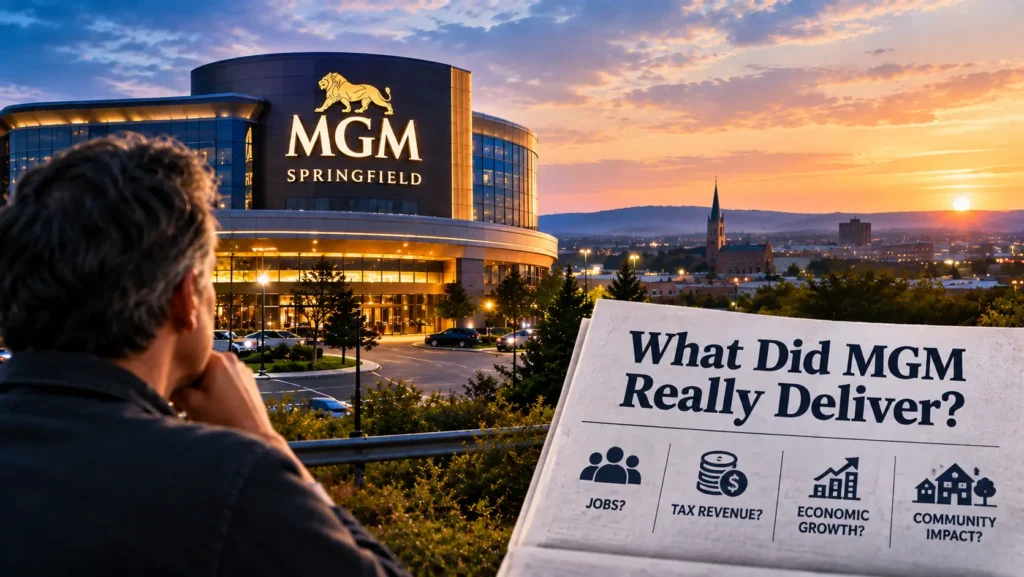
Why Is MGM Leaving Springfield in the First Place?
That’s the question hanging over Springfield’s South End right now, and it’s forcing a reckoning that’s been years in the making. MGM Resorts has already sold the real estate under its Massachusetts casino and is trying to sell the operating business too and the city isn’t signing off. Instead, on September 3, Springfield sued MGM and its subsidiary Blue Tarp Redevelopment in Hampden Superior Court, arguing the casino has spent years falling short of what it promised back in 2013.
A Decade of Expectations, and a Mixed Record
When MGM Springfield opened in August 2018, the pitch was ambitious: a nearly $960 million complex meant to jump-start a city still healing from a 2011 tornado. Then-CEO Jim Murren told reporters the project would put thousands of people to work in a city he called down on its luck. Early visitor numbers beat projections, and MGM leaned into that momentum publicly.
The Host Community Agreement behind the project spelled out specific commitments: at least 3,000 employees, 2,800-plus slot and video machines, 75 to 100 table games, and separately the redevelopment of a nearby building at 101 State Street into a hotel.
Springfield’s lawsuit says none of that held up. The casino employs roughly 1,500 people today, about half the pledge. Its gaming floor runs around 1,600 machines and 50 tables well under both original targets. And 101 State Street still sits undeveloped, even as other projects nearby have moved forward.
Two Years of Negotiation, Then Court
This isn’t a sudden dispute. City officials say they spent roughly two years trying to resolve the alleged shortfalls with MGM, including a round of arbitration, before filing suit. The timing lines up with MGM’s 2024 disclosure to Mayor Domenic Sarno that it had a buyer lined up for the casino, a disclosure that seems to have accelerated everything that followed.
MGM’s position is that the lawsuit is a stalling tactic. The company argues the real fight isn’t about jobs or table games at all, but about the city using its contractual approval rights over any sale to delay a transaction MGM wants to close. MGM called the suit “frivolous litigation” aimed at holding up its request to transfer the casino to a new operator.
What Business Owners Near the Casino Are Saying
For residents like Rico Daniele, whose family has run a business on Main Street in the South End for years, the numbers in the lawsuit aren’t abstract. He’s watched the casino absorb a large footprint of his neighborhood since before it opened, on the understanding that it would bring the kind of steady traffic and spillover business that never fully arrived. That frustration has resurfaced now that MGM’s own exit plans are public for many nearby merchants, the company trying to leave feels like confirmation that the original promises were oversold from the start.
The Stakes Beyond Springfield
This case matters well past one Massachusetts city. Host Community Agreements are common in U.S. casino licensing, and they typically bind operators to specific, measurable commitments headcounts, gaming-floor minimums, ancillary development that don’t expire when a company wants to sell. Springfield’s suit is effectively testing how much leverage a municipality retains when an operator wants out, and whether a city can hold up a sale until its underlying performance disputes are resolved.
For anyone evaluating an acquisition of a similarly bound casino property, the message is straightforward: those commitments travel with the license, not just the original owner.
What Comes Next
The case now sits in Hampden Superior Court. If Springfield prevails, MGM may have to either close the gap on jobs and gaming capacity or negotiate a settlement before any sale gets approved. If MGM prevails, the sale could move forward largely independent of the underlying dispute. Given how much both sides have riding on a resolution, a negotiated settlement before trial wouldn’t be surprising though there’s no public indication that talks have resumed.
FAQ
What is Springfield accusing MGM of?
Failing to meet 2013 Host Community Agreement commitments on staffing, gaming machines and tables, and a promised hotel conversion at 101 State Street and using its approval power over any casino sale as leverage in that dispute.
How big is the gap between what was promised and what exists today?
Roughly half the promised jobs (1,500 vs. 3,000) and well under half the promised gaming floor (1,600 machines and 50 tables vs. 2,800+ and 75+).
Is the casino actually being sold?
MGM has already sold the property and wants to sell the operating business too, but that requires Springfield’s approval under the same agreement now at the center of the lawsuit.
Suggested Internal Links
- What Host Community Agreements actually require of casino operators
- Massachusetts gaming market snapshot: MGM Springfield vs. Encore Boston Harbor
- How municipalities can block or delay a casino sale
- MGM Resorts’ regional divestitures, explained
Sources
- The Boston Globe “MGM, Springfield mayor in fight over sale of casino”
- Hoodline “Springfield Sues MGM to Block Casino Sale Over Broken Jobs, Tables Promises”
- Gambling News “Amid Future Uncertainty: MGM Springfield Faces New Questions”
- NewsNet5 “MGM Springfield’s Uncertain Future: Legal Battles and Community Impact”